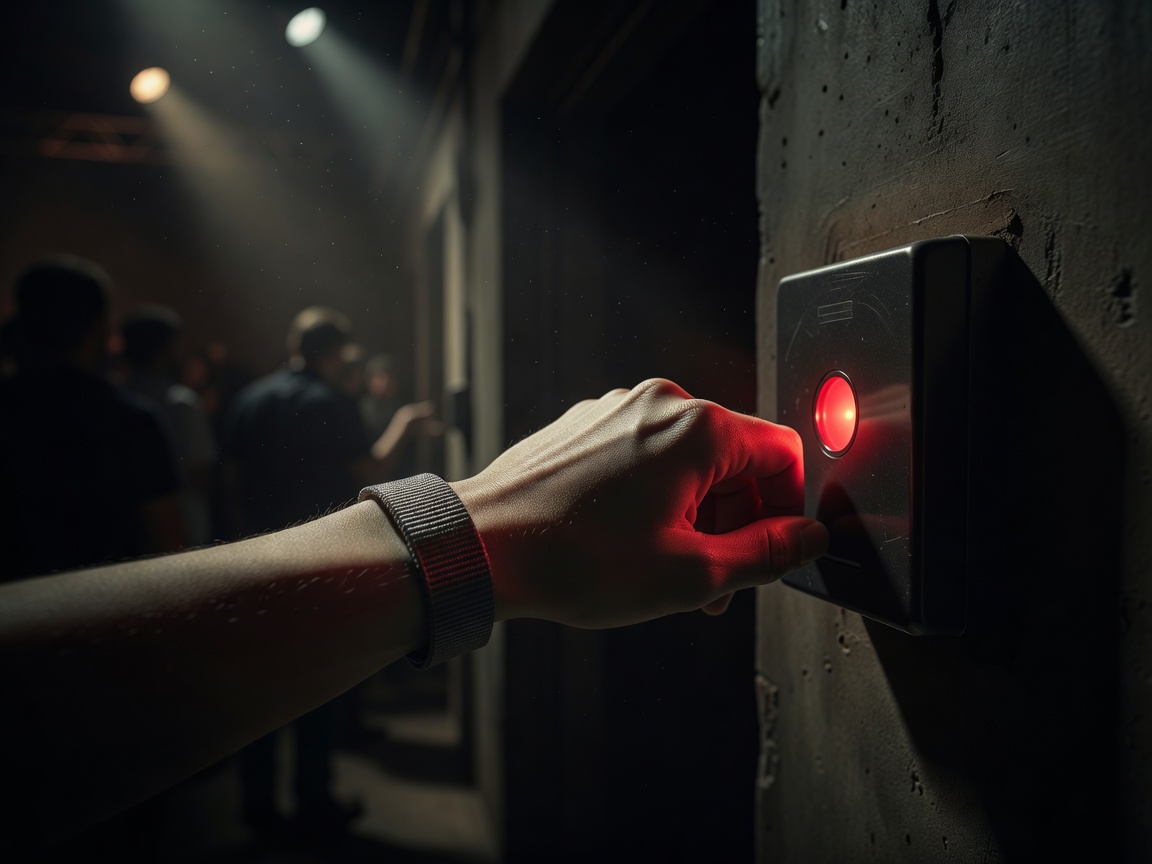
A quick tap is the visible part. Behind it sit a credential, a reader and an admission decision. Follow one attendee through the system—and separate what a band can do from what an event actually enables.
Field note 01 / A wearable credential is one component, not the whole access system.
Follow one admission
Issue. Present. Decide. Record. Every handover matters.
01 / Issue desk
Link the right band to the right entitlement
Our attendee exchanges a valid booking for a wristband. Staff verify the booking, fit the band and activate or associate its credential. A readable chip alone does not establish permission to enter.
Replacement and cancellation rules matter here. If a band is lost, the old credential should not silently remain a second working ticket.
Checkpoint 01 / Association and fit happen before the first admission.
02 / Entrance reader
A read becomes a decision
At the gate, the reader obtains credential data. Software checks the relevant permissions and returns an outcome. Depending on the deployment, those checks happen on a server, at a local controller or against a cached rule set.
A red response needs a clear next step, not repeated tapping without diagnosis. Staff distinguish an unreadable band from an expired entitlement, a repeated entry or a network problem.
Checkpoint 02 / The reader captures; the access system decides.
03 / Inside the venue
Beyond a successful scan
A wristband can also support cashless purchases, optional activities or synchronized light effects. None of those follows automatically from using RFID for admission.
Look for the extra components: a payment service, an activation station, a radio receiver or an optical control system. Ask whether participation is optional and what happens when equipment fails.
Checkpoint 03 / A light effect and an access credential may share a strap, not a system.
04 / Event exit
The data left behind
The band may leave with the attendee. Access logs, account links and transaction records can remain elsewhere. Those records deserve a retention plan before the first band is issued.
No. A passive RFID or NFC credential can draw energy from a nearby reader. Lighting and some longer-range communication designs usually need a separate power source.
Can I re-enter after leaving?
Only if the event’s rules and access configuration allow it. Ask before exiting; possessing the band is not a guarantee of re-entry.
Does the wristband track me continuously?
A passive access credential does not continuously broadcast its location. Reader encounters may still create time-and-place records. Other radio-equipped wearables can work differently.
Read the operating notes
Four focused guides, from the strap to the server.
Your privacy choices Some cookies are needed for the site to work. Others help us understand how it is used. You can change your choice later. Cookie policy